We often receive the same reference image from buyers who have already collected several very different quotations. The tables may look identical on screen, yet one price is based on lacquered MDF, another on a wood-look surface, and a third on a different base or packing method. Choosing a coffee table manufacturer therefore starts with understanding what each quotation actually represents.
The Same Coffee Table Image Can Produce Different Quotes
A reference image communicates the design direction, but it rarely explains the complete construction. It may show a round top and pedestal base without identifying the board grade, tabletop thickness, surface process, base material, hardware, or assembly method.
When we review an OEM inquiry, we first clarify where the table will be sold and how it should be positioned. A furniture retailer preparing a value-focused collection may make different material and packaging decisions from an importer supplying hotel lounges or residential projects. Quantity, destination market, target price, and expected delivery date all influence the suitable solution.
Dimensions matter as much as appearance. Increasing the diameter of a round coffee table affects more than its visual proportion. It may require changes to the tabletop structure, base, carton size, and container loading plan. A useful quotation should reflect these connections instead of attaching a price to an image alone.
Buyers can make the first discussion more productive by providing:
- A drawing or clear reference image
- Required dimensions and preferred materials
- Color and finish direction
- Estimated order quantity
- Target market and sales channel
- Packaging or labeling requirements
- Expected shipment date
Not every detail has to be final at this stage. However, open decisions should be identified clearly so that alternative quotations remain comparable.
A Suitable Manufacturer Asks About the Product Before the MOQ
A quick MOQ and unit price may appear efficient, but they reveal little if the supplier has not understood the table. We normally discuss the product structure before treating the quotation as final.
For an MDF coffee table, the board grade, thickness, surface finish, edge treatment, and underside all affect the finished item. For a model with a metal base, the shape, coating, fixing points, and hardware also need to work with the tabletop. Glass surfaces create another set of questions involving specifications, edges, attachment, and packing.
These details should be discussed as connected parts rather than isolated entries on a specification sheet. A heavy-looking top paired with an unsuitable base can affect proportion and stability. A visually clean fixing method may require a different assembly or packing solution. A finish that works well on one board construction may not create the same result on another.
This is where buyers can distinguish a general furniture trader from a supplier familiar with the required category. A capable coffee table supplier should be able to explain how the proposed materials, structure, finish, and packaging fit together.
The Sample Shows What the Quotation Cannot
A quotation can describe a finish, but it cannot fully show how the color reacts to light or how the surface feels. A drawing can state the dimensions, but it cannot confirm whether the completed table looks balanced in the intended space.
The sample closes that gap. During sample review, we focus on the overall proportion, tabletop finish, edge appearance, base alignment, assembly fit, and visible connection points. Comments should be specific enough to guide production. “Improve the finish” is difficult to apply consistently, while an approved color reference or clearly marked sample photograph gives both sides a usable standard.
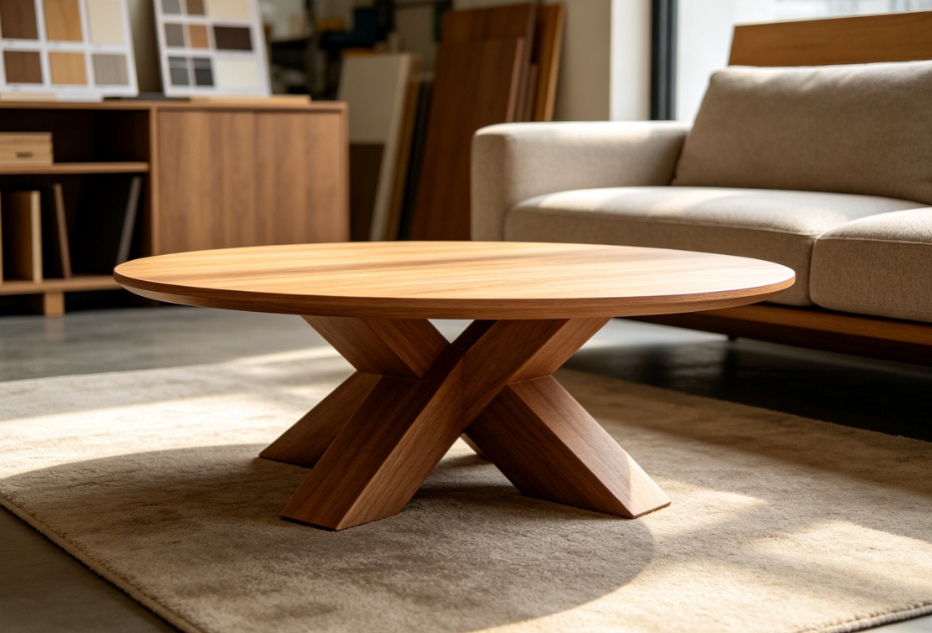
SANQ’s BJ-26802 offers a practical example. The listed model has an 800 mm round top made from 30 mm E1-grade MDF with a lacquered finish and a cross-shaped pedestal base. If a buyer keeps this construction, the quotation can follow the listed model more closely. If the buyer changes the diameter, color, finish, or base, we need to review how the change affects production and packing.
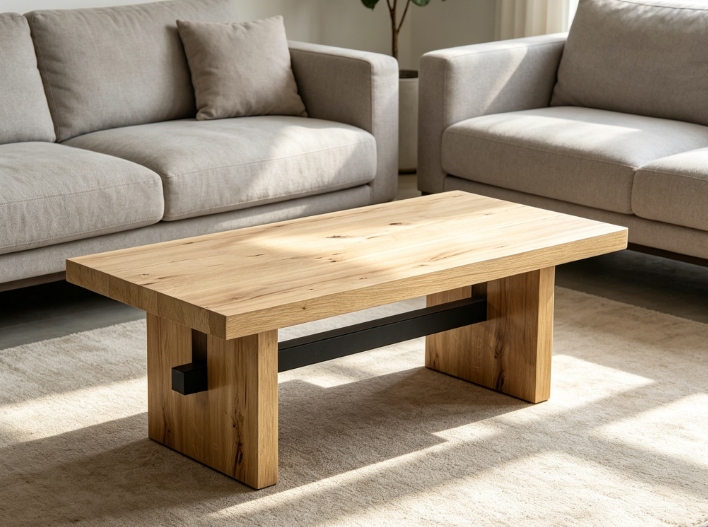
Wholesale wooden coffee tables require the same clarity. Solid wood, veneer over a core, lacquered MDF, and engineered board with a wood-look surface can produce related visual effects, but they are not interchangeable constructions. The sample should represent the material route stated in the final quotation.
Customization Usually Changes More Than the Color
OEM requests often begin with a change that sounds small: use another color, increase the diameter, add a logo, or replace the base. In practice, one revision may affect several parts of the order.
A new color can require an approved finish sample. A larger top may change the carton dimensions and loading quantity. A different base can affect hardware, assembly instructions, or internal carton layout. Customized packaging adds artwork approval and may influence the production schedule.
For this reason, we treat customization as a chain of connected decisions:
| Requested change | Possible commercial effect |
| Different tabletop size | Structure, carton volume and loading quantity |
| New surface finish | Sample approval and production schedule |
| Revised base | Hardware, assembly and packaging |
| Private label or barcode | Artwork confirmation and carton preparation |
| Added internal protection | Packing cost and usable container space |
Not every modification changes every term. The important point is to review the final configuration before confirming the price, MOQ, lead time, and loading plan.
Container Loading Can Change the Real Cost
The lowest unit price does not always produce the lowest landed cost. Coffee tables occupy substantial volume in relation to their selling price, so carton efficiency deserves attention early in the negotiation.
For BJ-26802, SANQ lists a 30-piece MOQ, a lead time of 30–45 days, one set per carton, a carton volume of 0.152 m³, and a loading quantity of 446 sets in a 40HQ container. These figures help a buyer estimate inventory commitment and freight use for that particular model.
They should not be applied automatically to a customized version. If the tabletop becomes larger or the internal protection changes, the carton volume may also change. If several models share one container, the actual loading plan will depend on the carton dimensions and quantity of each SKU.
From a wholesale perspective, we recommend looking at four figures together: unit price, MOQ, carton volume, and loading quantity. This provides a more realistic view of the order than the factory price alone. It also helps importers decide whether a model suits a trial order, a mixed collection, or a larger replenishment program.
Repeat Orders Are the Real Test of Supplier Fit
The first order introduces a product. Repeat orders determine whether it can remain part of a stable collection.
A reliable manufacturing arrangement keeps the approved drawing, material details, finish reference, and sample comments connected. This becomes especially important when buyers reorder several months later or combine related tables within one range. A small shift in color, tabletop thickness, base coating, or hardware may create inconsistency even when each item remains usable on its own.
Before volume production, the buyer and manufacturer should agree on the final product reference, accepted sample changes, packaging, quantity, and shipment terms. Any later revision that affects the product or order should be recorded rather than left inside a long email or message thread.
The purpose is not to create unnecessary paperwork. It is to make the next order easier. When both sides can return to the same approved information, repeat production becomes more efficient and commercial discussions become clearer.
What Helps Us Prepare an Accurate OEM Quote
A productive inquiry does not require a complete technical file. We can begin with a product image or drawing, but the quotation becomes more reliable when the buyer also shares the required dimensions, target material, finish direction, quantity, sales market, packaging needs, and schedule.
If some decisions remain open, we can discuss them as options instead of building assumptions into one price. This allows the buyer to compare practical alternatives and see which changes influence cost, MOQ, lead time, or shipping efficiency.
Planning an OEM range or wholesale program? Request a coffee table quotation with your reference design, target market, expected quantity, material preferences, and delivery plan.
FAQ
Should I compare coffee table manufacturers by unit price?
Unit price should be compared only after the construction, finish, quantity, packaging, incoterm, and lead-time basis are aligned. Otherwise, the quotations may represent different products.
Can I request a different size based on an existing coffee table?
Size customization may be possible, but it can affect the tabletop structure, base proportion, carton volume, and loading quantity. The revised configuration needs a separate review.
Why can a finish change affect the lead time?
A new finish may require material preparation and sample approval before production. The actual effect depends on the model and requested surface.
Can several coffee table models be loaded in one container?
Mixed-model loading may be possible. The final quantity depends on each model’s MOQ, carton dimensions, packing method, and the planned SKU combination.
What should be approved before production starts?
The buyer should approve the final drawing, materials, finish reference, sample changes, packaging, quantity, price, lead time, and shipment terms.